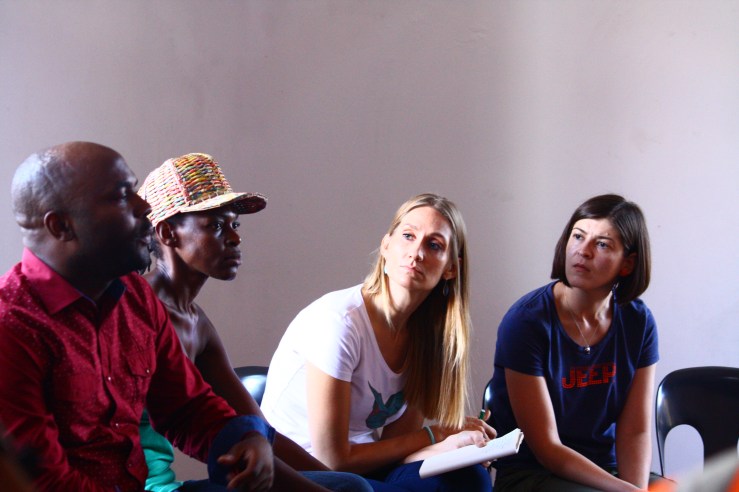
So there I was propping up a barn in Sweet Auburn, Atlanta. I was in town for a conference about racial justice (or the lack thereof) with my Consciousness Café colleague Keke. Two days before, Donald Trump had been elected president of the US, and the conference was a churned-up sea of angry, bewildered activists. After yet another day of high-intensity discussions, we’d gone out in search of beer.
Our taxi dropped us off on the corner of Edgewood and Boulevard, where a helicopter was whirring overhead, and police cars were parked up. In the distance we could hear drums and see flags waving, and as they got closer, we saw it was one of the many #NotMyPresident marches that were taking place across the US that day. There were probably about 300 white people, with a smattering of “people of colour”, being followed by a CBS news van, which was broadcasting this march live. The police stood back with their arms folded, watching bored, and I couldn’t help but wonder if the black faces had outnumbered the white faces, would the police have been so relaxed, and would the media have described it as peaceful? But I digress.
Within moments of entering the bar we immediately befriended two guys, one black, one white, who by some weird cast of fate, both had spent a lot of time in South Africa.
The white guy’s grandfather was Morris Nestadt, the former mayor of Benoni, the East Rand mining town where I had grown up, and he spent all his childhood summers there.
The black guy, LeJuano, was a mover and shaker who had spent six months living in Joburg’s trendy suburbs of Parkhurst and Maboneng, checking out the scene.
It was LeJuano, who, a few beers later, posed me the question: “How many white liberals do you think they are in South Africa?”
I hesitated. Contemplated. Took another sip of beer.
“That a difficult question,” I said.
Keke rolled her eyes. “Why is it difficult? Just answer the question,” she said.
“It’s difficult because it depends what you mean by liberal? Is it someone who believes in giving back the land? Or are you a liberal if you never say ‘I hate kaffirs’?”
“Mara,” says Keke. “Why are you complicating this?”
“Because it is complicated,” I said. “During apartheid, a white liberal was someone who didn’t support racial segregation. Back then, the DP – who are now the DA – were the liberals. But nowadays if you’re white and you vote for the DA, you are not seen as a liberal. In fact, liberal has become a dirty word, and those who would consider themselves the true liberals nowadays are what others would call the radicals. Those who fully support the EFF and “give back the land”. And if that’s the definition we are reaching for, then I’d say there are probably zero white liberals in South Africa. Or maybe ten a push.”
At which point LeJuano threw back his head and started laughing.
“You South Africans!” he said. “You’d never hear people in America talk like this.”
To which Keke rolled her eyes and demanded we stop talking about politics and order some more beers.
And so we did.
But ever since I’ve been promising that I would write about this because it has been on my mind a lot over the last six years. I initially wrote a whole chapter on liberalism for my book, Lost Where We Belong, and then took it out because I felt like I was posturing. Who the hell was I to stroke my beard and pontificate on liberalism? I didn’t even know what it really meant.
Which is perhaps, in essence, the problem.
Liberalism is a broad brushstroke. If you believe in tolerance, respect, freedom, dignity of the individual, multi-party democracy, the rule of law, accountability and the separation of powers, then you can probably call yourself a political liberal.
And by virtue of our Constitution, South Africa is, in essence, a liberal country. Most of these values are the founding values of the new South Africa, and surprising as it may seem, this nation of crotchety, recovering racists is actually collectively signed up to a liberal agenda.
But just like God gets a bad rap from the awful humans that sometimes do heinous acts in the name of God, so liberalism has got something of a bad rap from its association with a nation of recovering racists.
That said, often the real grind with liberalism in South Africa is more concerned with attitudes towards economic liberalism. Critics would argue – and I would agree – that a laissez faire approach to the economy only serves to benefit those who already have established networks, education and access to resources. And because of our unjust past, there is no equal playing field in South Africa, and so if we want to see a just and fair state – and not just a liberal state – then some level of state intervention is required.
This, of course, this brings us to the difficult conversation of what kind of state intervention is just and fair. And this is where it gets uncomfortable, and brings up the other “L” word: Land.
The 1913 Land Act forbade black people from owning land in South Africa. Throughout apartheid black people were forcibly removed from land close to the city centre, and forced to live away from desirable resources, networks and infrastructure.
For restitution to take place, for justice to be attained, it is believed that actions are going to have to be taken regarding reappropriation of land which are mostly uncomfortable, threatening, terrifying and unpalatable to the white people who live on that land.
And if the topic of “land” makes your mouth dry, your heart beat faster, and your eyes shut, does it mean you can no longer call yourself a liberal?
And if you continue to call yourself a liberal, but get sweaty palms at the mention of “land”, is it liberalism that is at issue? Or is it something else?
My favourite definition of liberalism comes from the philosopher Bertrand Russell, who wrote in his book, Unpopular Essays (after which this blog is named): “The essence of the liberal outlook lies not in what opinions are held, but in how they are held: instead of being held dogmatically, they are held tentatively and with a consciousness that new evidence may at any moment lead to their abandonment.”
No one ever says to a Jewish person, “get over the Holocaust already”. They know the facts and the facts continue to stun, shock and horrify. But again and again, we hear white people say that black people should “just get over apartheid”. But if we were really prepared to engage with the facts about how unfair, cruel and destructive apartheid was – and how its legacy continues to be – would people really say that?
Which is why, right now, it doesn’t matter how many liberals there are. What really matters is how many listeners there are.
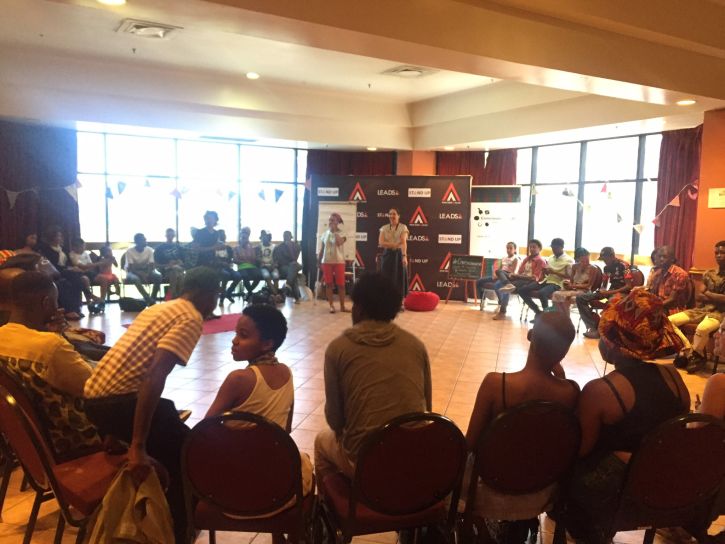
*Our next Consciousness Café dialogue is at the Joburg Theatre on Friday, 16 December, from 2-6pm. Free event. Full details here
Follow me on Twitter @writerclb

 unpopularessays.com